
Root Canal Treatment in Aurora
Root canal treatment removes infected or damaged tissue from inside a tooth so you can keep the tooth. The tooth is frozen first, and we explain each step as we go.
The short answer
Root canal treatment in Aurora at Aurora Gateway Dental cleans out the infected or injured pulp inside a tooth, then fills and seals the canals. It is done with local freezing and usually takes one or two visits. Afterward, most back teeth need a crown. The goal is to save your natural tooth instead of removing it.
- Visits
- 1 or 2 for the root canal, then 1 or 2 for the crown or filling
- Timeline
- Depends on the tooth; molars take longer
- Comfort
- Local freezing; tenderness for a few days is common
- Coverage
- Often a basic service under insurance; CDCP covers endodontic care
- Dentist
- Our dentists
At a glance
What it is
Inside every tooth is soft tissue called the pulp. It holds the nerve and blood vessels and runs down thin channels in the roots, called canals. Deep decay, a crack, a hard knock or repeated work on the same tooth can let bacteria in. The pulp then becomes inflamed or infected and cannot heal on its own.
Root canal treatment removes that tissue. The dentist makes a small opening through the chewing surface of the tooth, cleans and shapes each canal, rinses them with a disinfecting solution, then fills and seals them. The tooth no longer has a living nerve, but it stays in your jaw, held by the gum and bone around it, and you can chew on it.
A tooth that has had a root canal becomes more brittle. That is why back teeth usually need a crown afterward to keep them from cracking. Front teeth sometimes need only a filling. Your dentist will tell you which your tooth needs.
Our dentists provide root canal treatment here. If a case needs an endodontist, a dentist with advanced training in root canal care, we'll explain the referral.
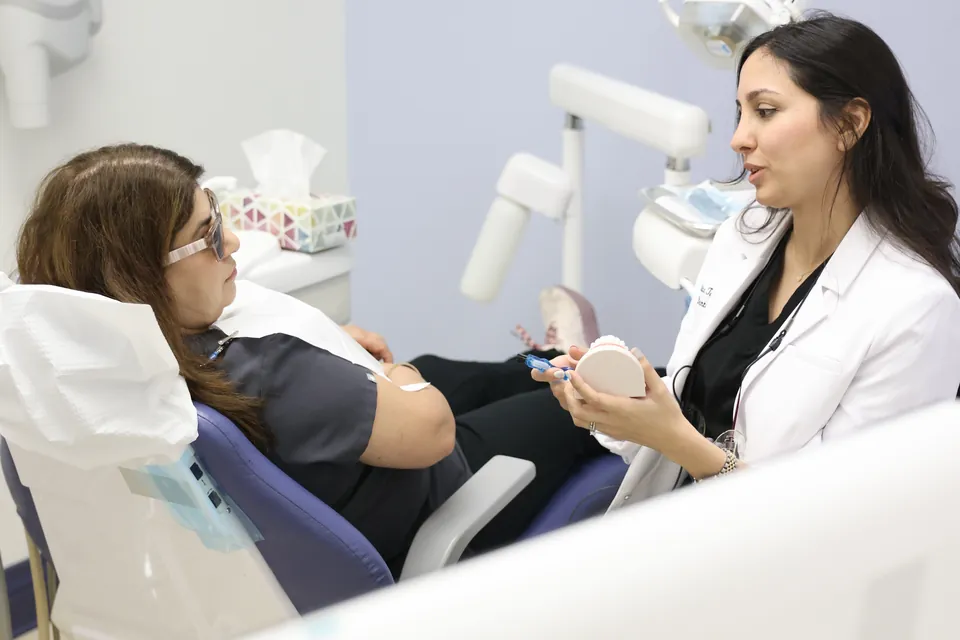
Is it right for me?
- A toothache throbs, wakes you at night or lingers after hot or cold.
- One tooth hurts when you bite down.
- Your gum is swollen or has a small pimple-like bump near a tooth.
- A tooth has turned darker after an injury.
- Your dentist says a deep cavity or crack has reached the nerve.
- You have no symptoms, but an infection shows on an X-ray.
Step by step
- DiagnosisYour dentist takes an X-ray and tests the tooth with cold and gentle tapping to see if the nerve is healthy, inflamed or dead.
- Freezing and isolationThe tooth and gum are numbed with local anaesthetic. A thin rubber sheet, called a dam, goes around the tooth to keep it clean and dry.
- Cleaning the canalsA small opening is made through the biting surface of the tooth. Tiny files clean and shape each canal, and the canals are rinsed with disinfecting solution.
- Filling and sealingThe canals are filled with a rubber-like material called gutta-percha and sealed. A temporary or final filling closes the opening.
- Rebuilding the toothAt a later visit, a crown or filling restores the tooth so it is strong enough for chewing.
How it compares
| Question | Root canal and crown | Extraction only | Extraction and replacement |
|---|---|---|---|
| Keeps your tooth | Yes | No | No |
| Gap left | No | Yes | Filled by implant, bridge or denture |
| Visits | Usually 2 to 4 | Usually 1 | Several |
| Recovery | A few days of tenderness | 1 to 2 weeks of healing | Weeks to months |
| Later effects | Tooth needs check-ups | Nearby teeth may drift | Depends on the option |
General information. Your dentist will explain what applies to you.
Benefits and risks
Benefits
- Saves your natural tooth, which is usually preferred when it can be done.
- Removes the source of infection and the pain that often comes with it.
- Keeps neighbouring teeth from drifting into a gap.
- Lets you chew normally on the tooth once it is restored.
Risks and limits
- The tooth may be tender for a few days to a week or two, especially when biting.
- Some teeth have extra or curved canals that are hard to clean, which lowers the chance of success.
- A treated back tooth can crack if it is not protected with a crown.
- Infection can sometimes return, and the tooth may then need retreatment, surgery or removal.
- Rarely, a tiny instrument can break inside a canal. Your dentist will explain what that means if it happens.
Cost and coverage
The cost of a root canal depends mostly on the tooth. A front tooth often has one canal, while a molar can have three or four, and each one takes time to find, clean and fill. Fees are based on the Ontario Dental Association fee guide. Plan for the crown or filling that follows, which is billed separately. Many insurance plans cover root canals as a basic service and crowns as a major one. CDCP covers endodontic treatment for eligible patients, and we accept IFHP and direct bill all plans. Your written estimate lists both steps before we begin.
What shapes your estimate
- Which tooth: front teeth often have one canal, molars three or more
- Whether it is a first treatment or a retreatment
- Whether a post and core build-up is needed
- The crown or filling needed afterward
- Whether the case is referred to an endodontist
- Your insurance coverage for root canals and crowns
Read more about insurance and payment, the Canadian Dental Care Plan and IFHP coverage.
After your visit
- Avoid chewing on the tooth until the freezing is gone, and go easy on it until the final crown or filling is in.
- Over-the-counter pain relievers usually manage tenderness. Follow the label or your dentist's advice.
- Call us if you have severe pain, swelling that gets worse, or a bite that feels high.
- Book your crown appointment promptly so the tooth is protected.
- Brush and floss the tooth like any other. It can still get decay and gum disease.
Questions
Does a root canal hurt?
The tooth is frozen first, so you should feel pressure rather than sharp pain. Many people arrive already in pain, and treatment aims to relieve it. Some tenderness for a few days afterward is normal.
How long does a root canal take?
Treatment usually takes one or two visits. Molars with more canals take longer than front teeth. Your dentist will tell you what to expect for your tooth.
Can I just take antibiotics instead?
Antibiotics can help if infection spreads, but they cannot clean out dead or infected tissue inside the tooth. Without treatment, the infection usually comes back. The lasting options are root canal treatment or removing the tooth.
Do I really need a crown after a root canal?
Back teeth usually do, because chewing puts heavy force on them and treated teeth become more brittle. Some front teeth only need a filling. Your dentist will advise based on how much tooth is left.
Is it better to just pull the tooth?
Keeping your own tooth is usually preferred when it can be saved. Removal is sometimes the right choice, such as when a tooth is badly cracked or too little is left to rebuild. Replacing a missing tooth later also adds time and cost.
What if my face is swelling now?
Call us at 289-475-5497 and we will try to see you as soon as possible. If we're closed, follow the instructions on our line. If swelling affects your breathing or swallowing, or spreads toward your eye or neck, call 911 or go to the nearest emergency department.
Reviewed by the dentists at Aurora Gateway Dental Care. Last updated October 28, 2026. This page is general information, not personal medical advice.
Your dentists
Five dentists share the care at our clinic. Your dentist will explain your options at your exam.
Meet the team →Trusted health information
Related treatments
Patients visit from
Newmarket · Oak Ridges, Richmond Hill · East Gwillimbury · King City · Stouffville
Ask us about root canal treatment
289-475-5497Prefer to type? Send a request and we'll contact you to confirm a time.
676 Wellington Street East, Unit 3
Aurora, ON L4G 0K3