
Crowns and Bridges in Aurora
A crown covers a weak or broken tooth. A bridge fills a gap by joining a replacement tooth to the teeth beside it. Both are custom-made and stay fixed in your mouth.
The short answer
Crowns and bridges in Aurora at Aurora Gateway Dental are fixed restorations made for your mouth. A crown caps a damaged tooth to protect and strengthen it. A bridge replaces one or more missing teeth by joining a false tooth to crowns on the neighbouring teeth or on implants. Both usually take two visits.
- Visits
- Usually 2, a couple of weeks apart
- Timeline
- Longer first visit; shorter fitting visit
- Comfort
- Local freezing; temporary worn in between
- Coverage
- Often a major service under insurance; CDCP covers some crowns
- Dentist
- Our dentists
At a glance
What it is
A crown is a cap that covers the whole visible part of a tooth. It is used when a tooth is too damaged for a filling to hold: after a large break, a deep crack, a very big old filling or root canal treatment. The crown holds the tooth together and takes the force of chewing, so the tooth underneath is less likely to split.
A bridge replaces a missing tooth with nothing to take out at night. The false tooth, called a pontic, sits in the gap. It is joined to crowns that fit over the teeth on each side. When there are not enough healthy teeth to hold a bridge, it can be attached to dental implants instead.
Crowns and bridges come in several materials. All-ceramic and porcelain look most like natural teeth and suit the front of the mouth. Gold and other metals are very strong, so they can suit back molars. Porcelain fused to metal blends the two. Your dentist will match the material to the tooth's job and to how it will look.
Dr. Ali Karimi, one of our dentists, is an instructor in prosthodontics at the University of Toronto. Prosthodontics is the area of dentistry that deals with crowns, bridges and other ways to restore and replace teeth.
Is it right for me?
- A tooth has a large filling that is cracking or breaking down.
- You had root canal treatment on a back tooth.
- A tooth is cracked and hurts when you bite and release.
- A tooth is badly worn down from grinding.
- You are missing one or two teeth in a row, and the teeth beside the gap are strong.
- You want a fixed replacement rather than one you take out.
Step by step
- PlanYour dentist examines the tooth or gap, takes X-rays and checks your gums and bite. If a tooth needs a root canal or gum care first, that comes before the crown.
- Shape the toothAfter freezing, the tooth is reshaped so the crown has room to fit. For a bridge, the teeth on each side of the gap are shaped the same way.
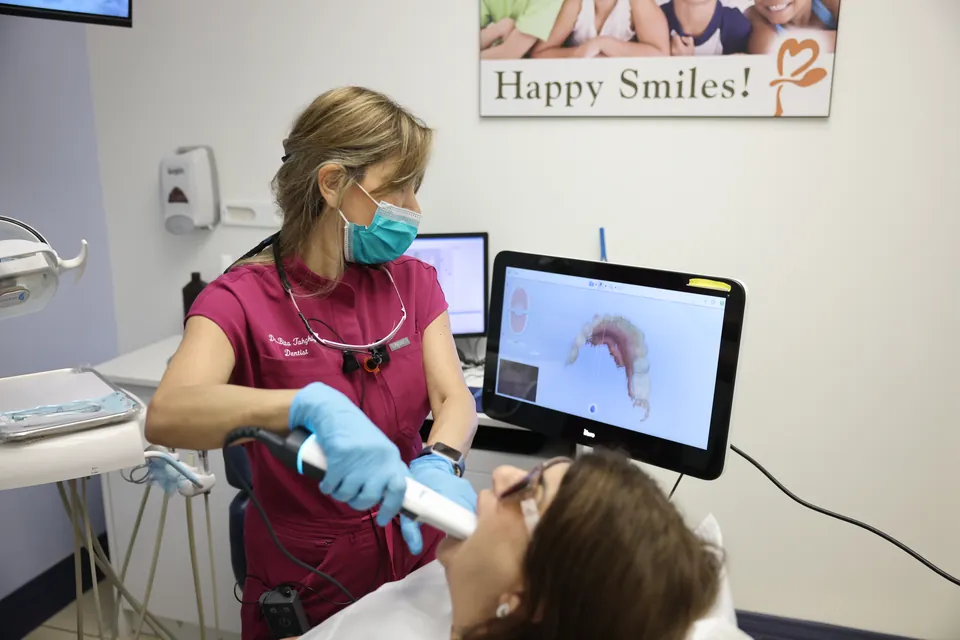
- ImpressionA mould or scan records the exact shape of your teeth and bite. The shade is matched to your nearby teeth.
- TemporaryA temporary crown or bridge protects the shaped teeth while your final one is made.
- Fit and cementAt the second visit, your dentist checks the fit, colour and bite, then cements the final crown or bridge in place.
How it compares
| Question | Bridge | Dental implant | Partial denture |
|---|---|---|---|
| Fixed or removable | Fixed | Fixed | Removable |
| Effect on nearby teeth | Neighbours are shaped | None | Clasps rest on them |
| Surgery | No | Yes | No |
| Treatment time | Usually 2 visits | Several months | A few visits |
| Cleaning | Floss threader under it | Brush and floss like a tooth | Take out to clean |
General information. Your dentist will explain what applies to you.
Benefits and risks
Benefits
- A crown can save a cracked or weak tooth that might otherwise need to come out.
- Both are fixed in place, and you brush and floss them like your own teeth.
- A bridge fills a gap and helps stop nearby teeth from tipping into it.
- Shade and shape are matched to your smile.
- Chewing on that side feels steady again.
Risks and limits
- Shaping a tooth for a crown removes healthy enamel, and this cannot be undone.
- A tooth may be sensitive after shaping. In some cases the nerve becomes inflamed and needs root canal treatment.
- Porcelain can chip, and crowns can come loose. Both can often be repaired or cemented again.
- If the teeth holding a bridge get decay or gum disease, the whole bridge can be at risk.
- Crowns and bridges do not last forever. With good care, many last 10 years or longer.
Cost and coverage
A crown or bridge is priced per unit, so a three-unit bridge has three parts: two crowns and the false tooth between them. Each unit includes the dentist's fee, based on the Ontario Dental Association fee guide, and a lab fee for making it. Many insurance plans list crowns and bridges as major services, which often have lower coverage and waiting periods, so we usually send a predetermination to your insurer first. We direct bill all plans and accept CDCP and IFHP; CDCP covers some crowns and may need approval in advance. You receive a written estimate before we start, and our treatment and financial coordinator can go over it with you.
What shapes your estimate
- Number of crowns, or how many units your bridge has
- The material chosen and the dental lab fee
- Whether a tooth needs a core build-up or post first
- Whether root canal or gum treatment is needed before the crown
- Whether implants are used to support a bridge
- Your insurance coverage for major services
Read more about insurance and payment, the Canadian Dental Care Plan and IFHP coverage.
After your visit
- With a temporary, avoid sticky foods like caramel and gum, and slide floss out to the side instead of pulling it up.
- Clean under your bridge every day with a floss threader, super floss or a small brush.
- Avoid chewing ice, pens or hard candy, and do not use your teeth to open packages.
- If you grind at night, ask about a night guard to protect your new crown.
- Keep regular check-ups so your dentist can check the edges where crown meets tooth.
Questions
How long does a crown last?
With good care, crowns often last 10 years or more. How long yours lasts depends on the material, your bite, grinding habits and how well the edges are kept clean. Your dentist checks crowns at each visit.
Does getting a crown hurt?
The tooth is frozen before it is shaped, so you should feel pressure rather than pain. Your gums may be sore for a day or two after. Tell us if you feel anything during treatment and we can stop.
How many visits does a crown or bridge take?
Most take two visits a couple of weeks apart. The first is for shaping and the impression. The second is to fit the final one. Extra steps, like a root canal, add visits.
Can a bridge replace more than one tooth?
Yes. A bridge can replace one or more teeth in a row if the supporting teeth are strong enough. If several teeth are missing, an implant bridge or a partial denture may fit better.
What if my temporary crown comes off?
Call us so we can put it back on. Until then, keep the temporary somewhere safe and avoid chewing on that side. Temporary dental cement from a pharmacy can hold it for a short time.
Will my crown match my other teeth?
We match the shade to your neighbouring teeth. If you plan to whiten your teeth, do it before the crown is made, because crowns do not change colour with whitening.
Reviewed by the dentists at Aurora Gateway Dental Care. Last updated October 28, 2026. This page is general information, not personal medical advice.
Your dentists
Five dentists share the care at our clinic. Your dentist will explain your options at your exam.
Meet the team →Trusted health information
Related treatments
Patients visit from
Newmarket · Oak Ridges, Richmond Hill · East Gwillimbury · King City · Stouffville
Ask us about crowns and bridges
289-475-5497Prefer to type? Send a request and we'll contact you to confirm a time.
676 Wellington Street East, Unit 3
Aurora, ON L4G 0K3