Dental X-Rays: How Often and Are They Safe?
By Aurora Gateway Dental Care · Published October 29, 2026 · Updated October 29, 2026 · Reviewed by our dentists
The short answer
How often you need a dental X-ray depends on your risk of decay and gum disease, your age and any symptoms, not on a set calendar. Children may need them more often than healthy adults. Each dental X-ray uses a low dose of radiation, and Health Canada says they should be taken only after a clinical exam shows a need.
Why your dentist takes a dental X-ray
A dental X-ray lets your dentist see what a mirror and a light can't. That includes decay between teeth or under old fillings, infection at the tip of a root, bone loss from gum disease, cracks, and teeth that haven't come in. Health Canada notes that X-rays help dentists diagnose conditions that are hard to see and plan treatment safely.
X-rays also create a record. Comparing new images with older ones shows whether something is changing, which helps your dentist decide whether to treat now or simply watch.
Common types of dental X-rays
You may hear these names at your visit:
- Bitewings: show the crowns of the back teeth, upper and lower together, and are used to find decay between teeth.
- Periapicals: show a whole tooth from crown to root tip, often used when one tooth hurts.
- Panoramic: one wide image of all the teeth and both jaws, useful for wisdom teeth and growth.
- A full series: a set of images covering every tooth, sometimes taken at a first visit.
- 3D imaging: used in some cases, such as planning implants.
How often dental X-rays are needed
There's no single schedule that fits everyone. The American Dental Association says the timing depends on your oral health, age, risk of disease and any signs or symptoms. Children and teens may need X-rays more often because their teeth and jaws are still developing.
The Canadian Dental Association notes that a healthy adult who hasn't had cavities or other problems for a couple of years probably won't need X-rays at every appointment. If you get cavities often, have gum disease or have a lot of dental work, your dentist may suggest them more often.
Are dental X-rays safe?
Health Canada describes the radiation dose from each dental X-ray as low, and the risk of harm as generally low. Even so, it says that limiting exposure across the whole population still matters, so X-rays should be used only when they add useful information.
Health Canada also advises that X-rays follow a clinical exam rather than be taken as routine screening without one. When you change dentists, your new office should try to get your earlier X-rays instead of taking new ones.
Pregnancy, children and lead aprons
If you are or might be pregnant, tell your dentist before any X-rays. Some images can wait, and your dentist can talk through what is needed now.
You may notice fewer lead aprons and thyroid collars than in the past. The ADA's 2024 recommendations say shielding is no longer needed for patients of any age, because a collar can block part of the image and mean a retake. Some offices still use it because of local rules, and you can always ask.
Dental X-ray cost and coverage
There's no single dental X-ray cost, because it depends on the type and number of images. A couple of bitewings at a checkup are a different service from a full series or a panoramic image. In Ontario, each dentist sets their own fees, and many refer to the Ontario Dental Association's suggested fee guide.
Most dental plans cover X-rays but limit how often each type is paid for. Government programs such as the Canadian Dental Care Plan set limits too. If you're unsure what your plan allows, ask the office to check before images are taken.
Questions you can ask
It's reasonable to understand why an X-ray is being taken. Try asking:
- Why do I need X-rays today?
- What type are you taking, and what are you looking for?
- Can you use X-rays from my previous dentist?
- When am I likely to need them again?
X-rays at our Aurora office
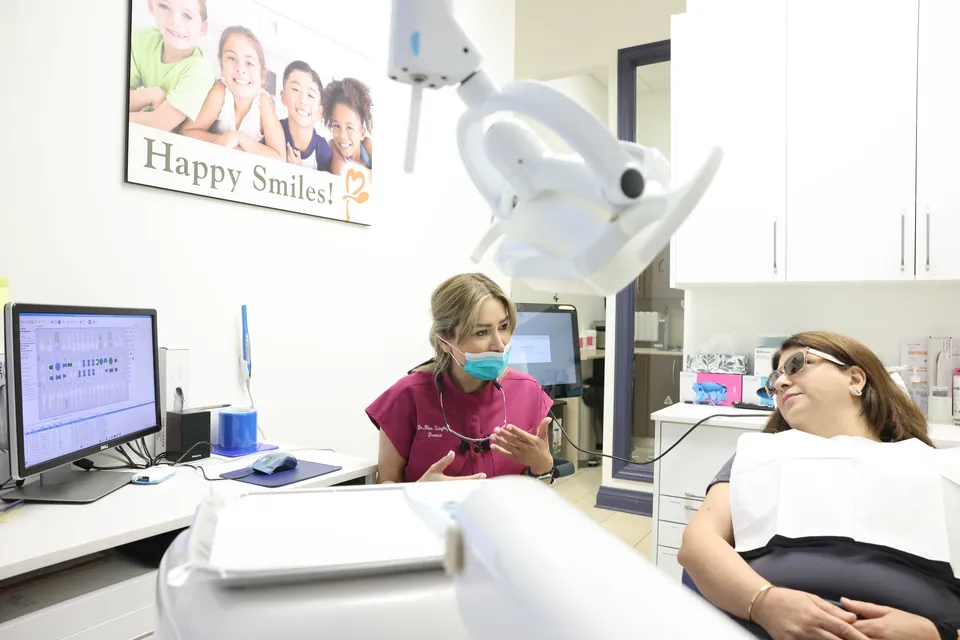
If you're in Aurora or nearby, our office uses digital X-rays, and our dentists take them when your care calls for them. If you're new to us, we can ask your previous dentist for recent images, and we're glad to show you your X-rays on screen and explain what they show.
Questions
Can I say no to X-rays?
You can decline, and your dentist should explain what may be missed without them. Some problems, such as decay between teeth or bone loss, can't be seen in a visual exam. You can talk through the timing together.
Do dental X-rays cause cancer?
The dose is low, and Health Canada describes the risk of harm as generally low. Because radiation exposure adds up over a lifetime, dentists aim to take X-rays only when they're useful.
Why does my new dentist want X-rays when I just had some?
They may not have your earlier images yet. Ask the new office to request them from your last dentist. If they're recent and clear, new ones may not be needed.
Are digital X-rays different from film?
Digital sensors show the image on screen right away, and it can be enlarged to look at details. The ADA notes that modern equipment has helped lower doses compared with the past.
Do children need dental X-rays?
Sometimes. Children's teeth and jaws change quickly, so X-rays can help check for decay between baby teeth and see how adult teeth are coming in. Your dentist decides based on your child's risk and what they see in the exam.
General information, not personal medical advice. If you have pain, swelling or an injury, call us at 289-475-5497.