
Dental Bridges in Aurora
A bridge fills a gap with a replacement tooth that stays in place. There is more than one kind, and the right one depends on the teeth beside the gap.
The short answer
A dental bridge replaces one or more missing teeth with a false tooth held in place by the teeth or implants beside the gap. It is cemented and does not come out. At Aurora Gateway Dental in Aurora, your dentist checks the neighbouring teeth, gums and bite, then explains which type of bridge suits the space.
- Visits
- Usually two, plus planning
- Timeline
- A few weeks while the bridge is made
- Comfort
- Local anaesthetic while teeth are shaped
- Coverage
- Often a major service under insurance; CDCP rules vary, so we check
- Dentist
- Our dentists
At a glance
What it is
When a tooth is lost, the gap does more than change your smile. Nearby teeth can tip into the space, the opposite tooth can drift toward it, and chewing shifts to the other side. A tooth bridge closes the space with a false tooth, called a pontic, that is attached to supports on one or both sides.
Bridges come in several designs. A traditional bridge uses crowns on the teeth on each side of the gap. A cantilever bridge is held from one side only, which can suit a gap with a healthy tooth on just one side. A resin-bonded bridge, sometimes called a Maryland bridge, attaches a false front tooth to small wings bonded to the back of the neighbouring teeth, so those teeth need little shaping. An implant-supported bridge rests on implants instead of natural teeth, which helps when several teeth are missing in a row.
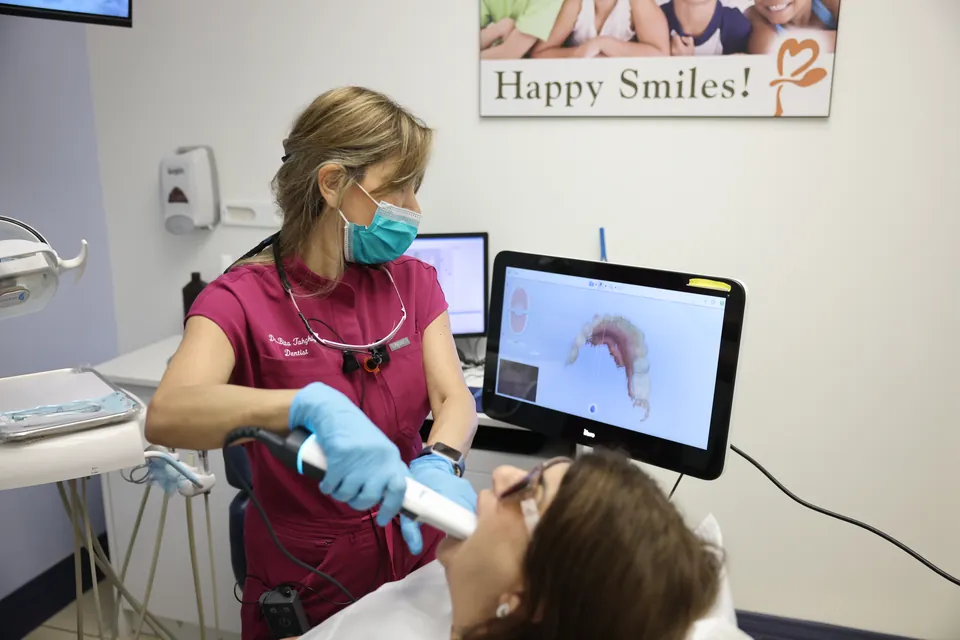
Choosing a bridge for a missing tooth depends on the teeth that will hold it. If the neighbouring teeth already have large fillings or crowns, covering them with crowns as part of a bridge can protect them too. If they are untouched and healthy, you may prefer an option that leaves them alone, such as an implant. Your dentist will explain the trade-offs using your X-rays and, where helpful, digital scans of your teeth.
Our crowns and bridges page covers materials and the two-visit process in detail. Here we focus on bridge types, who they suit and how to keep one clean, since the area under the false tooth needs a little extra attention.
Is it right for me?
- You are missing one tooth, or two or three in a row.
- The teeth beside the gap are healthy and firm, or already need crowns.
- You would rather not wear a replacement you take in and out.
- Implant surgery is not right for you now, or you prefer to avoid it.
- Your gums are healthy, or gum disease is being treated first.
Step by step
- Assess the gapYour dentist checks the supporting teeth, their roots and the gum in the gap, using X-rays and an exam. Bite and opposing teeth are checked too.
- Choose the designYou hear which bridge types would work, how each affects the neighbouring teeth, and the cost of each. You also hear about non-bridge options.
- Prepare the supportsThe supporting teeth are numbed and shaped as the design needs, and an impression or digital scan is taken. A temporary bridge protects them.
- Fit the bridgeThe finished bridge is tried in, checked for fit, shade and bite, then cemented or bonded in place.
- Learn to clean itWe show you how to thread floss or use small brushes under the false tooth, and check the bridge at your regular visits.
How it compares
| Question | Traditional bridge | Resin-bonded bridge | Implant-supported bridge |
|---|---|---|---|
| Held by | Crowns on teeth both sides | Wings bonded behind nearby teeth | Dental implants |
| Shaping of nearby teeth | Yes, for crowns | Little | None |
| Often used for | Front or back gaps | A front tooth | Several missing teeth |
| Surgery | No | No | Yes, to place implants |
General information. Your dentist will explain what applies to you.
Benefits and risks
Benefits
- Fixed in place, so there is nothing to remove at night.
- Helps keep nearby and opposite teeth from drifting into the gap.
- Restores chewing on that side and fills out your smile.
- Usually finished in a few weeks without surgery.
Risks and limits
- Shaping healthy teeth for crowns cannot be undone.
- Supporting teeth can still decay at the edges of their crowns, and if one fails, the bridge may need to be replaced.
- Food and plaque collect under the false tooth unless it is cleaned daily.
- Resin-bonded bridges can come loose and may need to be re-bonded.
- The bone in the gap can slowly shrink, since there is no root there.
Cost and coverage
A bridge is priced by its parts: each supporting crown or wing, each false tooth, and the lab work behind them. Our fees use the Ontario Dental Association fee guide as a reference. Many insurance plans treat bridges as a major service, which often means a lower percentage paid, a waiting period or a yearly maximum, so we usually send a predetermination before starting. Coverage under the Canadian Dental Care Plan and IFHP depends on each program's rules, and we check what applies to you. We bill all insurance plans directly. Ask about our in-house dental plan, student program and flexible payment options. Your written estimate lists each part of the bridge.
What shapes your estimate
- How many teeth are missing and how many supports are needed
- The bridge design and material
- Whether supporting teeth need fillings, root canal treatment or gum care first
- Lab fees for making the bridge
- Whether implants are part of the plan
Read more about insurance and payment, the Canadian Dental Care Plan and IFHP coverage.
After your visit
- Chew carefully on a temporary bridge and avoid sticky foods until the final bridge is fitted.
- Clean under the false tooth every day with a floss threader, super floss or a small brush.
- Brush along the gumline of the supporting teeth, where decay often starts.
- Keep regular checkups so the supports can be checked with X-rays from time to time.
Questions
How do I floss under a bridge?
Use a floss threader to pull floss under the false tooth, then slide it against the side of each supporting tooth. Some people find thicker bridge floss or a water flosser easier. We will show you at your fitting.
Can a bridge be taken out?
A fixed bridge is cemented or bonded and can only be removed by a dentist. That is different from a partial denture, which you take out to clean.
Do the teeth next to the gap have to be filed down?
For a traditional bridge, yes, they are shaped for crowns. A resin-bonded bridge needs much less shaping, and an implant-supported bridge leaves them alone. Your dentist will tell you which designs fit your gap.
How long does a dental bridge last?
With good daily cleaning and regular checkups, many bridges last around ten years and sometimes longer. Decay or gum disease around the supporting teeth is the most common reason a bridge needs replacing.
Is a bridge or an implant better for one missing tooth?
Neither is right for everyone. An implant leaves nearby teeth untouched but needs surgery and healing time. A bridge is faster and avoids surgery but relies on the neighbouring teeth. Your dentist will compare both for your mouth.
Will my bridge feel strange at first?
It may feel slightly bulky for a few days while your tongue gets used to it. If your bite feels high or a spot stays sore, call us for an adjustment.
Reviewed by the dentists at Aurora Gateway Dental Care. Last updated October 29, 2026. This page is general information, not personal medical advice.
Your dentists
Five dentists share the care at our clinic. Your dentist will explain your options at your exam.
Meet the team →Trusted health information
Related treatments
Patients visit from
Newmarket · Richmond Hill · Oak Ridges, Richmond Hill · East Gwillimbury · Holland Landing · Mount Albert · King City · Nobleton · Stouffville · Bradford
More about crowns and bridges
From our patient blog
Ask us about dental bridges
289-475-5497Prefer to type? Send a request and we'll contact you to confirm a time.
676 Wellington Street East, Unit 3
Aurora, ON L4G 0K3