Chipped, Cracked or Broken Tooth Repair in Aurora
Teeth break in different ways, from a tiny corner chip to a crack you can only feel when you bite. The repair depends on where the damage is and how deep it goes.
The short answer
A cracked tooth can often be saved if it is checked early. Small chips may need only smoothing or a tooth-coloured filling, while deeper cracks may need a crown or root canal treatment. At Aurora Gateway Dental in Aurora, your dentist finds the crack, explains how far it goes and recommends the simplest repair that will hold.
- Visits
- 1 visit for small repairs; 2 or more for crowns or root canal treatment
- Timeline
- Depends on the size and depth of the break
- Comfort
- Local freezing when needed; we explain each step first
- Coverage
- Repairs are often covered under basic or major services
- Dentist
- Our dentists
At a glance
What it is
A broken tooth is not always obvious. A chipped tooth is easy to see or feel with your tongue. A cracked tooth can hide. You might only notice a sharp jolt when you bite on something, a twinge with cold drinks, or pain that comes and goes and is hard to pin to one tooth. The American Association of Endodontists notes that, unlike a broken bone, a crack in a tooth does not heal on its own, and it can slowly grow.
Dentists sort the damage into a few kinds. Craze lines are fine surface lines in the enamel that usually need no treatment. A fractured cusp is a piece of the chewing surface that breaks off, often next to a large filling. A cracked tooth has a line running from the chewing surface down toward the root. A split tooth has separated into parts. A crack can also start in the root and go unnoticed until the gum around it gets infected.
Each one is repaired differently. A small chip can often be smoothed or rebuilt with tooth-coloured bonding. A fractured cusp usually needs a larger filling or a crown to brace the tooth. When a crack reaches the nerve, root canal treatment and a crown may save the tooth. If the crack runs deep below the gum, the tooth may not be savable, and your dentist will talk with you about removal and replacement. We use intraoral cameras and digital X-rays to show you what we see.
Sports injuries, falls, biting on a popcorn kernel, and years of grinding are common causes. Teeth with big old fillings or past root canal treatment are more likely to crack.
Is it right for me?
- You have a chipped front or back tooth, with or without pain.
- A tooth hurts sharply when you bite and then let go.
- One tooth is suddenly sensitive to cold or sweet.
- A piece of tooth or filling broke off while eating.
- You took a hit to the mouth during sports or a fall.
- You grind your teeth and can feel a rough edge or line.
Step by step
- Call and describe the breakPhone 289-475-5497. Tell us when it happened, whether you have pain or bleeding, and whether you saved any pieces.
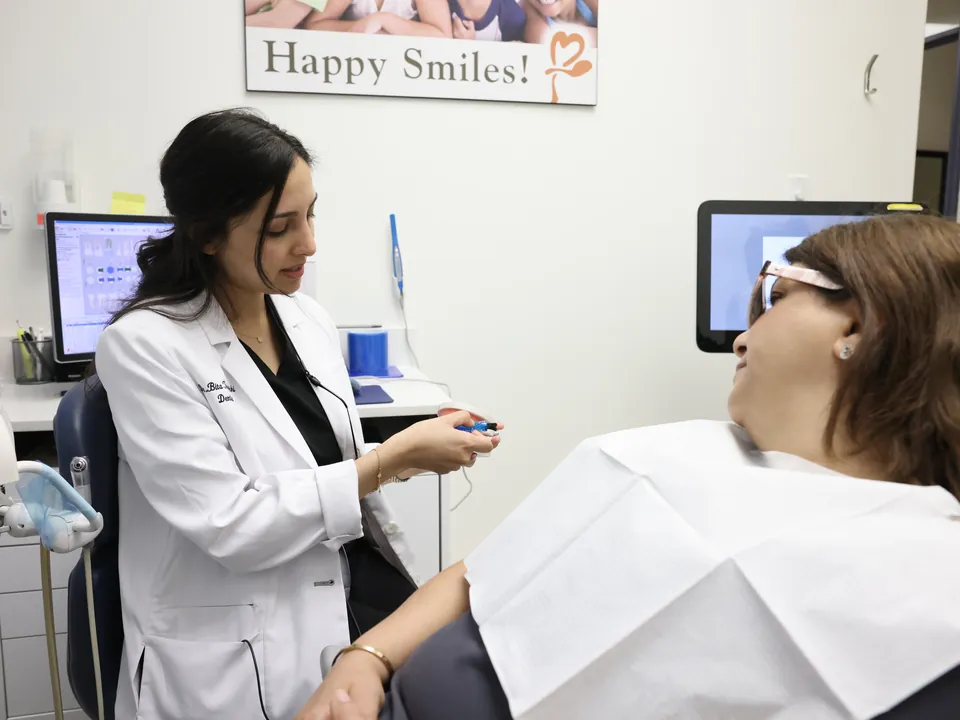
- Find the crackYour dentist looks closely, may ask you to bite on a small tool, and takes an X-ray. An intraoral camera can show you the crack on a screen.
- Settle it firstIf needed, a sharp edge is smoothed or a temporary covering protects the tooth until the final repair.
- RepairDepending on the damage, this may be bonding, a filling, a crown, or root canal treatment followed by a crown.
- Protect it afterwardsIf grinding or sports played a part, we may suggest a night guard or a sports mouthguard.
How it compares
| Question | Bonding or filling | Crown | Root canal and crown |
|---|---|---|---|
| Usually for | Small chips, minor breaks | Large breaks, cracked cusps | Cracks or breaks reaching the nerve |
| Visits | Often 1 | Usually 2 | 2 or more |
| Tooth reshaped | Very little | Shaped to fit a cap | Opened, then shaped for a cap |
| Supports a weak tooth | Limited | Yes, covers and braces the tooth | Yes |
General information. Your dentist will explain what applies to you.
Benefits and risks
Benefits
- Early repair can stop a small crack from turning into a split tooth.
- Smoothing a sharp edge protects your tongue and cheek.
- A crown can hold a cracked tooth together and spread biting force.
- Most chipped teeth can be rebuilt to look natural.
Risks and limits
- Some cracks keep growing even after a crown, and a tooth may still need treatment later.
- Cracks can be hard to see, so it may take more than one visit to confirm which tooth is affected.
- A tooth that seems fine after repair can later need root canal treatment if the nerve was injured.
- A crack that runs below the gum line may mean the tooth cannot be saved.
- Bonding can chip again, especially on edges used for biting.
Cost and coverage
What a broken tooth repair costs depends on what the exam finds: a small chip might need one short visit, while a cracked tooth that needs a crown or root canal treatment involves more steps. Fees follow the Ontario Dental Association fee guide as our reference. Many insurance plans cover fillings as basic services and crowns as major services, often at different rates. We bill all plans directly and can send a predetermination for larger work. The Canadian Dental Care Plan and IFHP include many restorative services for eligible patients; we check your coverage with you. Ask about our in-house dental plan and student program. You'll get a written estimate before treatment.
What shapes your estimate
- How large the break is and where it is
- Whether the nerve is affected
- Bonding, filling or crown material chosen
- X-rays and any temporary covering
- Whether a guard is advised to protect the repair
Read more about insurance and payment, the Canadian Dental Care Plan and IFHP coverage.
After your visit
- Chew on the other side until the final repair is in place.
- Avoid ice, hard candy and using your teeth to open packages.
- Wear a mouthguard for contact sports and a night guard if you grind.
- Call us if the tooth becomes painful to bite on or sensitive again.
Questions
What should I do right after I break a tooth?
Rinse with warm water and save any pieces in a little milk or a clean container. Hold a cold pack on your cheek for swelling. Call us at 289-475-5497; if we're closed, follow the instructions on our line.
Can a cracked tooth heal on its own?
No. Enamel and dentin do not knit back together like bone. A crack can stay stable or slowly grow, so it is worth having it checked even if the pain comes and goes.
My chipped tooth does not hurt. Does it still need repair?
Not always urgently, but it should be checked. A small chip can leave a sharp edge or a weak spot that breaks further. Your dentist will tell you if smoothing or bonding is enough.
Can you glue the broken piece back on?
Sometimes, if the piece is clean and fits well. Keep it moist and bring it with you. Often a filling or bonding gives a stronger result.
When should I go to the hospital instead?
Go to an emergency department or call 911 for a possible broken jaw, a head injury, heavy bleeding that will not stop with pressure, or swelling that affects breathing or swallowing. For a knocked-out adult tooth, see our article on handling a knocked-out tooth and call us right away.
Why does my tooth only hurt when I stop biting?
Pain when you release your bite is a classic sign of a cracked tooth. The crack opens slightly under pressure and closes when you let go, irritating the nerve. Your dentist can test each tooth to find the one causing it.
Reviewed by the dentists at Aurora Gateway Dental Care. Last updated October 29, 2026. This page is general information, not personal medical advice.
Your dentists
Five dentists share the care at our clinic. Your dentist will explain your options at your exam.
Meet the team →Trusted health information
Related treatments
Patients visit from
Newmarket · Richmond Hill · Oak Ridges, Richmond Hill · East Gwillimbury · Holland Landing · Mount Albert · King City · Nobleton · Stouffville · Bradford
More about emergency dental care
From our patient blog
Request a visit
289-475-5497Prefer to type? Send a request and we'll contact you to confirm a time.
676 Wellington Street East, Unit 3
Aurora, ON L4G 0K3