
Dental Bonding in Aurora
Bonding is sculpting with tooth-coloured resin. It can rebuild a chipped corner, close a small gap or reshape a tooth, usually with little or no drilling.
The short answer
Composite bonding adds tooth-coloured resin to the surface of a tooth, shapes it by hand and hardens it with a light. At Aurora Gateway Dental in Aurora, we use it to repair chips, close small gaps, even out uneven edges and cover some marks, often in one visit. Your dentist first checks that the tooth and gums are healthy.
- Visits
- Often one visit
- Timeline
- Depends on how many teeth are bonded
- Comfort
- Often no freezing needed; we check with you
- Coverage
- Cosmetic bonding is often not covered; repair of a broken tooth may be
- Dentist
- Our dentists
At a glance
What it is
Dental bonding uses composite resin, the same family of material as a white filling. Instead of filling a hole, though, your dentist adds it to the outside of the tooth to change its shape or cover a flaw. The resin is built up in thin layers, each one shaped and set with a curing light, then polished so it reflects light much like enamel.
Bonding shines in a few specific situations. A front tooth chipped on a water bottle or in a fall can often be rebuilt in one visit. A small gap between the two front teeth can be closed by adding resin to the sides of both teeth. A tooth that is smaller or more pointed than its neighbour can be built out to match. Notches worn into teeth at the gumline can be covered, which may also ease sensitivity there. Some stains and white spots can be masked when whitening cannot lift them.
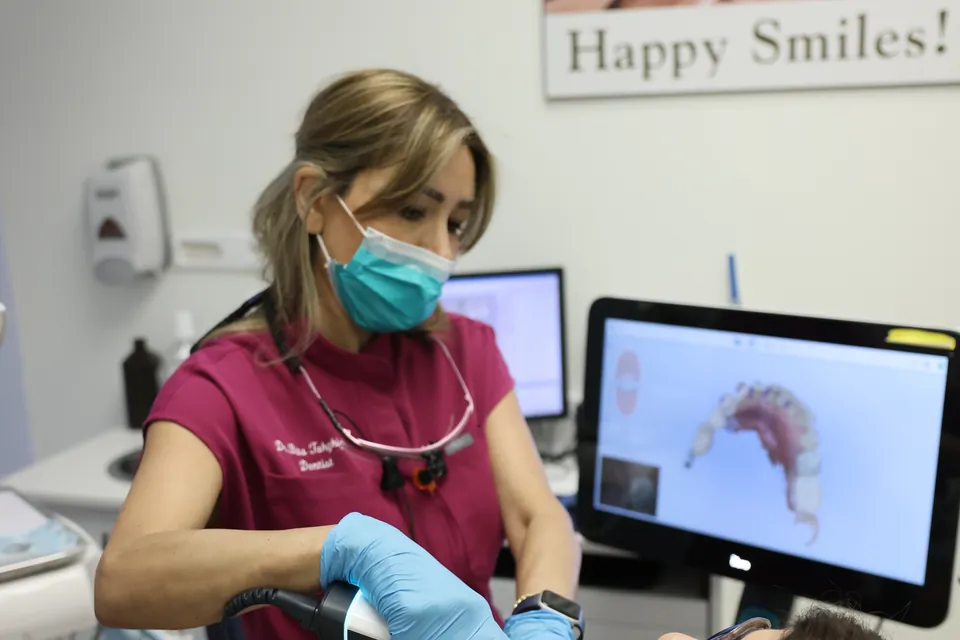
Good tooth bonding starts with planning. Your dentist looks at how your teeth meet, because resin on a biting edge takes a lot of force. They also choose the shade with you in natural light. If you are thinking of whitening, it usually comes first, because composite resin bonding keeps the shade it was made in. Dr. Bita Tahghighi, who has advanced training in cosmetic and aesthetic dentistry, is part of our team, and any of our dentists will talk you through what bonding can and cannot change.
How long bonding lasts on front teeth, and what shortens its life, is covered in our patient article on dental bonding, linked below with our related treatments.
Is it right for me?
- You have a small chip or rough edge on a front tooth.
- There is a small gap between two teeth that bothers you.
- One tooth looks shorter or narrower than the teeth around it.
- You have a notch at the gumline that catches your toothbrush or feels sensitive.
- You want a change that keeps as much natural tooth as possible and can be adjusted later.
Step by step
- Smile and bite checkYour dentist checks the teeth and gums, looks at how you bite and asks what you would like to change.
- Choose the shadeA shade guide is held next to your teeth, sometimes with a small test dab of resin, to find the closest match.
- Prepare the surfaceThe tooth is cleaned and lightly roughened, then a bonding liquid is applied so the resin will grip.
- Build and shapeResin is added in layers and sculpted by hand. Each layer is set with a blue curing light.
- Polish and reviewThe bonding is trimmed, polished and checked against your bite. You look in the mirror and we fine-tune the shape with you.
How it compares
| Question | Composite bonding | Porcelain veneer | Orthodontics |
|---|---|---|---|
| Closing a small gap | Adds width to teeth | Covers and reshapes teeth | Moves teeth together |
| Enamel removed | Little or none | A thin layer | None |
| Time to result | Often one visit | Usually two or more visits | Months |
| Can be reversed | Usually | No | Retainers keep the result |
General information. Your dentist will explain what applies to you.
Benefits and risks
Benefits
- Little or no healthy tooth needs to be removed.
- Often finished in a single appointment.
- Can be repaired or added to if it chips.
- You help choose the shade and shape while you are in the chair.
Risks and limits
- Resin is softer than enamel and porcelain, so it can chip, especially on biting edges.
- It can pick up stains from coffee, tea, red wine and smoking over time.
- Bonding does not lighten with whitening gel, so a later whitening can leave it looking darker than your teeth.
- Large changes or teeth under heavy grinding may be better served by another option.
- Bonding is not a fix for teeth that are badly crowded or out of line.
Cost and coverage
Bonding fees depend on how many teeth are treated and how many surfaces of each tooth are built up. Our fees follow the Ontario Dental Association fee guide. Insurance plans often treat bonding done for looks as cosmetic and may not pay for it, while rebuilding a tooth broken in an accident may be handled as a repair. We can send a predetermination so you know before you start. We bill all insurance plans directly and accept the Canadian Dental Care Plan and IFHP, each with its own rules on what is covered. Ask about our in-house dental plan and student program. You get a written estimate first.
What shapes your estimate
- How many teeth are bonded
- How much each tooth is being changed
- Whether whitening is planned first
- Whether the bonding repairs damage or is for looks, which affects insurance
- Whether any decay or gum treatment is needed first
Read more about insurance and payment, the Canadian Dental Care Plan and IFHP coverage.
After your visit
- For the first day or two, go easy on coffee, tea, red wine and smoking while the surface settles.
- If your bite feels uneven or an edge feels sharp to your tongue once you get home, call us for a quick smoothing.
- Avoid using bonded teeth to bite fingernails, open packages or crack ice.
- Keep your regular cleanings so the bonding can be checked and polished.
Questions
Can bonding straighten a crooked tooth?
Bonding can make a slightly turned or uneven tooth look more even by adding resin where it is needed. It does not move the tooth. For teeth that are clearly out of line, your dentist may suggest orthodontics first and bonding afterwards, if it is still needed.
Can bonding close the gap between my front teeth?
A small gap can often be closed by adding resin to the sides of the two teeth. If the gap is large, closing it with resin alone may make the teeth look too wide. Your dentist may suggest orthodontics or a combination.
Will people be able to tell my tooth is bonded?
The shade and shape are matched to your own teeth, and the surface is polished to reflect light like enamel. Over time, resin can stain slightly differently from natural teeth, and a polish at your cleaning helps.
Can bonding cover a dark or grey tooth?
Light marks and small stains can often be masked. A tooth that has turned dark from the inside, for example after an injury or root canal treatment, is harder to cover with a thin layer of resin. Your dentist may talk about whitening that tooth from within, a veneer or a crown.
Is dental bonding the same as a filling?
They use similar materials. A filling replaces tooth lost to decay. Bonding adds to the outside of a healthy tooth to change its shape or cover a flaw.
Reviewed by the dentists at Aurora Gateway Dental Care. Last updated October 29, 2026. This page is general information, not personal medical advice.
Your dentists
Five dentists share the care at our clinic. Your dentist will explain your options at your exam.
Meet the team →Trusted health information
Related treatments
- Veneers and Bonding
- What Is Dental Bonding and How Long Does It Last on Front Teeth?
- Teeth Whitening
- Cosmetic Dentistry
Patients visit from
Newmarket · Richmond Hill · Oak Ridges, Richmond Hill · East Gwillimbury · Holland Landing · Mount Albert · King City · Nobleton · Stouffville · Bradford
More about veneers and bonding
From our patient blog
Ask us about dental bonding
289-475-5497Prefer to type? Send a request and we'll contact you to confirm a time.
676 Wellington Street East, Unit 3
Aurora, ON L4G 0K3