
Tooth Fillings in Aurora
A filling closes up the hole that decay leaves behind, so the tooth can do its job again. Most fillings are done in one visit with the tooth numbed.
The short answer
A cavity filling removes the decayed part of a tooth and replaces it with a material that seals and rebuilds it. At Aurora Gateway Dental in Aurora, we place tooth-coloured fillings that blend with your enamel. Your dentist checks the tooth and takes X-rays if needed before explaining what the filling involves.
- Visits
- Usually one visit per area
- Timeline
- Depends on the size and number of fillings
- Comfort
- Local anaesthetic for most fillings; tell us if you feel anything
- Coverage
- Often a basic service under insurance; CDCP lists fillings
- Dentist
- Our dentists
At a glance
What it is
A cavity is a spot where acid from plaque bacteria has dissolved part of the tooth. Once the surface breaks down into a true hole, it cannot grow back. A filling stops the damage from spreading. Your dentist removes the soft, decayed part, shapes the space so a filling will stay in, and then rebuilds the tooth so you can bite and clean it normally.
Most of the fillings we place are tooth-coloured. These are also called white fillings or composite fillings. Composite is a resin with fine glass-like particles in it. It goes on soft, gets shaped to match the tooth, and is hardened with a blue light. Because it bonds to the enamel, your dentist can often keep more healthy tooth than older methods needed. Glass ionomer is another tooth-coloured material that releases a little fluoride, and it can suit some spots near the gumline or in baby teeth.
Not every dark spot needs a filling right away. A small area of early decay that has not broken through the enamel can sometimes be watched and helped with fluoride and better cleaning. A cavity that is growing, has reached the inner layer of the tooth, or is causing pain usually needs to be filled. If a lot of the tooth is gone, your dentist may suggest a crown instead, because a very large filling can leave thin walls that crack.
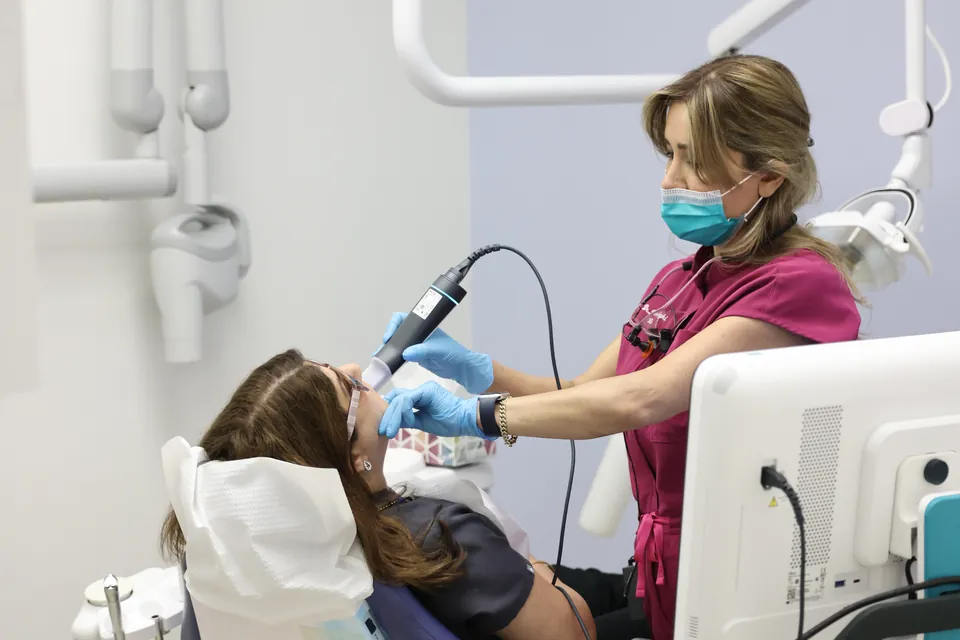
If you would like to see what your dentist sees, ask. Our intraoral camera can show a close-up of the tooth on a screen, and your digital X-rays can show decay between teeth that is hidden from view.
Is it right for me?
- Your dentist has found a cavity on your X-rays or during your exam.
- A tooth feels sharp to your tongue, catches floss, or traps food in one spot.
- You notice a twinge with cold, sweet or hot food in the same tooth.
- An old filling has chipped, cracked, or has a dark edge where decay is creeping in.
- A small chip on a back tooth needs rebuilding but the tooth is otherwise strong.
Step by step
- Check the toothYour dentist looks at the tooth, reviews any X-rays and tells you how deep the decay seems to be. You can ask about materials before anything starts.
- NumbingA gel is rubbed on the gum, then local anaesthetic is given. Small, shallow fillings sometimes do not need it, and you can decide with your dentist.
- Remove the decayThe soft, decayed part is cleaned out with a small drill and hand tools. A thin band or wedge may be placed to shape a filling between two teeth.
- Bond and buildThe tooth is kept dry, a bonding liquid is brushed on, and the composite is added in thin layers. Each layer is hardened with a curing light.
- Shape and polishYour dentist shapes the filling, checks your bite with thin marking paper and smooths any high spots so your teeth meet evenly.
How it compares
| Question | Composite filling | Glass ionomer filling | Crown |
|---|---|---|---|
| Colour | Matched to your tooth | Tooth-coloured, less glossy | Matched, if ceramic |
| Suits | Small to medium cavities | Low-stress spots, gumline areas | Large damage or cracks |
| Visits | Usually one | Usually one | Usually two |
| Tooth removed | Only the decay, in most cases | Only the decay, in most cases | Tooth is shaped all around |
General information. Your dentist will explain what applies to you.
Benefits and risks
Benefits
- Stops decay from spreading deeper toward the nerve.
- Tooth-coloured material blends in, even on teeth that show when you smile.
- Bonded fillings often let your dentist keep more natural tooth.
- Usually done in a single visit.
Risks and limits
- Some sensitivity to cold or biting pressure is common for a few days or weeks after a filling.
- A deep cavity close to the nerve can still become inflamed later and may need root canal treatment.
- Composite can wear, stain at the edges or chip over time, and no filling lasts forever.
- Large fillings can leave weaker tooth walls that may crack.
- A filling cannot stop new decay from starting around its edges if plaque is left there.
Cost and coverage
The fee for a filling depends mostly on its size, measured by how many surfaces of the tooth it covers, and on where the tooth sits in your mouth. Our fees follow the Ontario Dental Association fee guide. Many insurance plans list fillings as a basic service, but some pay for a white filling on a back tooth at the rate for a silver one, so part of the fee may be yours. We direct bill all insurance plans and accept the Canadian Dental Care Plan and IFHP, which each have their own rules. If you have no coverage, ask about our in-house dental plan and student program. You get a written estimate before we begin.
What shapes your estimate
- How many teeth need fillings
- How many surfaces of each tooth are involved
- The material chosen, since plans may treat back-tooth white fillings differently
- Whether X-rays are needed first
- Whether a deep cavity needs a protective liner or a temporary filling
Read more about insurance and payment, the Canadian Dental Care Plan and IFHP coverage.
After your visit
- Wait until the numbness wears off before you eat, so you do not bite your cheek or tongue.
- Composite is hard when you leave, but chew carefully on that side for the rest of the day.
- If your bite feels high or uneven once the freezing fades, call us. Smoothing a high spot takes only a moment.
- Mild cold sensitivity often settles over a few weeks. Tell us if it gets worse or turns into a throbbing ache.
Questions
Does getting a cavity filled hurt?
Most people feel pressure and vibration rather than pain, because the tooth is numbed first. You may feel a pinch with the needle. If you feel anything sharp during the filling, raise your hand and we will stop and add more freezing.
How long will my mouth stay numb?
It varies with the type of anaesthetic and where it was given. Lower teeth often stay numb longer than upper teeth. Many people find the feeling comes back within a few hours.
Are white fillings strong enough for back teeth?
For small and medium cavities, composite holds up well on back teeth. For very large cavities or people who grind hard, your dentist may talk about a crown instead. They will explain why for your tooth.
Why is my filled tooth sensitive?
The tooth has just been worked on, so a little sensitivity to cold or pressure is common and usually fades. If biting hurts, the filling may be slightly high and need smoothing. Pain that lingers or throbs should be checked.
What is a temporary filling?
A temporary filling is a softer material used to seal a tooth for a short time. Your dentist might use one when a cavity is very deep and they want to see how the nerve settles. It needs to be replaced with a lasting filling or crown.
Can I fill several cavities in one visit?
Often, yes, especially if they are on the same side of your mouth. Your dentist will suggest how to group them so you are numb in as few areas as possible. If you prefer shorter visits, tell us when you book.
Reviewed by the dentists at Aurora Gateway Dental Care. Last updated October 29, 2026. This page is general information, not personal medical advice.
Your dentists
Five dentists share the care at our clinic. Your dentist will explain your options at your exam.
Meet the team →Trusted health information
Related treatments
Patients visit from
Newmarket · Richmond Hill · Oak Ridges, Richmond Hill · East Gwillimbury · Holland Landing · Mount Albert · King City · Nobleton · Stouffville · Bradford
More about restorative dentistry
From our patient blog
Ask us about tooth fillings
289-475-5497Prefer to type? Send a request and we'll contact you to confirm a time.
676 Wellington Street East, Unit 3
Aurora, ON L4G 0K3