Laser-Assisted Gum Treatment in Aurora
A dental laser is one more tool for treating gum disease. Used alongside a thorough deep cleaning, it can help in some pockets. It works with standard care, not instead of it.
The short answer
Laser gum treatment uses a dental laser alongside scaling and root planing to help treat gum disease in selected pockets. At Aurora Gateway Dental in Aurora, your dentist may suggest laser-assisted care after measuring your gums. Studies show results similar to, or slightly better than, deep cleaning alone, so it supports standard treatment rather than replacing it.
- Visits
- Usually added to deep cleaning visits
- Timeline
- Adds some time to each treated area
- Comfort
- Local anaesthetic is often used; we check in as we go
- Coverage
- Plans vary on laser use; we check before treatment
- Dentist
- Our dentists
At a glance
What it is
Gum disease lives in the pockets between the gums and teeth. The foundation of treatment is always the same: remove the tartar and bacteria from the root surfaces, then keep the area clean. That is what scaling and root planing does. A dental laser can be added in some cases to help treat the soft tissue lining an inflamed pocket.
A laser is a narrow beam of light energy delivered through a thin tip. Depending on the type of laser and its settings, it can be used to reduce bacteria in a pocket and remove inflamed tissue from the pocket wall while the root itself is cleaned with standard instruments. Each laser has its own safe settings, and using it well takes training. Two of our dentists have laser dentistry training: Dr. Bita Tahghighi holds a Fellowship in Laser Dentistry from Germany, and Dr. Farhad Sobouti completed advanced laser dentistry training at the University of Genoa.
It helps to be clear about what the research shows. The American Academy of Periodontology reports that when a laser is used in addition to mechanical cleaning, results are similar to or slightly better than cleaning alone. It found no added benefit over traditional gum surgery. In other words, laser periodontal therapy can be a useful extra in some situations, but it is not a shortcut around a deep cleaning, daily home care or regular maintenance.
Your dentist will tell you honestly whether laser-assisted care is likely to help you, which pockets it would be used on, and what you can expect. If your gum disease is advanced and needs surgery, they will explain a referral.
Is it right for me?
- You have gum pockets that need scaling and root planing.
- Some pockets stayed deep or kept bleeding after an earlier deep cleaning.
- You want to hear every non-surgical option before considering a referral.
- Your general health allows routine dental treatment with local anaesthetic.
- You are ready to keep up home care and maintenance visits afterwards.
Step by step
- Gum assessmentYour gums are measured, bleeding spots are noted and X-rays show the bone. Your dentist decides whether a laser would add anything for you.
- Options and estimateYou hear what deep cleaning alone involves, what the laser would add, and the cost of each, so you can choose.
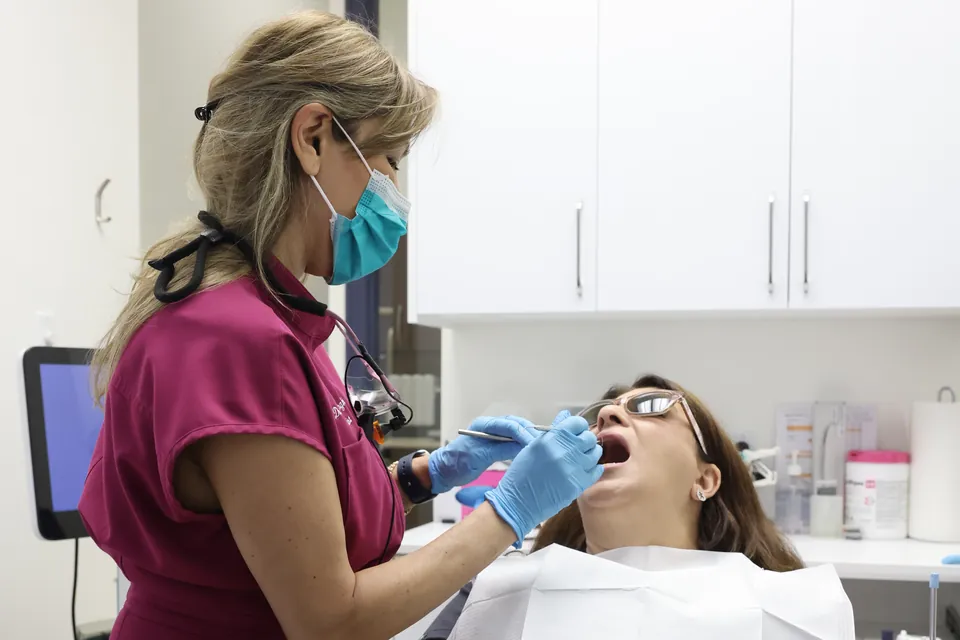
- Protective glassesEveryone in the room, including you, wears safety glasses while the laser is in use.
- Clean and treatThe area is numbed if needed. Roots are cleaned with standard instruments, and the laser is used on the selected pockets.
- Healing and re-checkGums are re-measured some weeks later to see how they responded, and your maintenance schedule is set.
How it compares
| Question | Deep cleaning plus laser | Deep cleaning alone | Gum surgery (referral) |
|---|---|---|---|
| Root cleaning | Yes, with instruments | Yes, with instruments | Yes, with direct access |
| Cut and stitches | No | No | Usually |
| Evidence | Similar or slightly better than cleaning alone | Standard first treatment | For pockets that need more access |
| Maintenance after | Needed | Needed | Needed |
General information. Your dentist will explain what applies to you.
Benefits and risks
Benefits
- Can be added to a deep cleaning without cuts or stitches.
- May help with pockets that stayed inflamed after cleaning alone.
- Fits into the same numbed visits as your deep cleaning.
- Gives your dentist another non-surgical option to discuss.
Risks and limits
- Laser-assisted care does not replace scaling and root planing. Roots still need to be cleaned with instruments.
- Benefits shown in research are modest, and results vary from person to person.
- Wrong settings can damage gum or bone, which is why training and careful technique matter.
- You may still have some tenderness, swelling or sensitivity for a few days.
- If pockets stay deep, you may still need a referral for surgery.
Cost and coverage
Laser-assisted care is priced in addition to the deep cleaning it goes with, so your estimate shows both parts separately. Fees follow the Ontario Dental Association fee guide. Insurance plans differ in how they handle laser use for gum treatment: some pay toward it, and others pay only for the scaling. A predetermination is the clearest way to know before you begin. We bill all insurance plans directly and accept the Canadian Dental Care Plan and IFHP under their own rules. If you have no coverage, ask about our in-house dental plan and student program. You get a written estimate before treatment, and you can choose deep cleaning without the laser.
What shapes your estimate
- How many pockets or areas are treated with the laser
- Whether scaling and root planing is done at the same visits
- Whether X-rays are needed first
- How your plan treats laser-assisted gum care
- The maintenance schedule afterwards
Read more about insurance and payment, the Canadian Dental Care Plan and IFHP coverage.
After your visit
- Eat soft foods and avoid very hot, spicy or crunchy food for a day or two.
- Brush gently around the treated areas from the first evening, then return to your normal routine.
- Avoid smoking, which slows gum healing.
- Call us if swelling increases after the second day or you develop a fever.
Questions
Is laser gum treatment better than a deep cleaning?
It is not a replacement. Research shows a laser added to deep cleaning gives results similar to or slightly better than deep cleaning alone. Your dentist will tell you whether the extra step is likely to help in your case.
Does laser gum disease treatment hurt?
Most people feel little during treatment because the area is usually numbed. Some tenderness afterwards is common. Tell us if anything feels uncomfortable and we will stop.
Is the laser safe?
Dental lasers are used routinely when the operator is trained and uses the right settings. You and the team wear protective glasses during treatment.
Will I still need maintenance cleanings?
Yes. Gum disease can come back if plaque builds up again. Regular maintenance visits and daily home care are what keep results over time.
Can a laser help with receding gums?
Laser-assisted care targets the inflamed pockets of gum disease. It does not grow back gum that has receded. If recession is a concern, your dentist will explain the options.
Reviewed by the dentists at Aurora Gateway Dental Care. Last updated October 29, 2026. This page is general information, not personal medical advice.
Your dentists
Five dentists share the care at our clinic. Your dentist will explain your options at your exam.
Meet the team →Trusted health information
Related treatments
Patients visit from
Newmarket · Richmond Hill · Oak Ridges, Richmond Hill · East Gwillimbury · Holland Landing · Mount Albert · King City · Nobleton · Stouffville · Bradford
More about periodontics (gum care)
From our patient blog
Request a visit
289-475-5497Prefer to type? Send a request and we'll contact you to confirm a time.
676 Wellington Street East, Unit 3
Aurora, ON L4G 0K3