
Invisalign or Braces: How to Choose
By Aurora Gateway Dental Care · Published October 29, 2026 · Updated October 29, 2026 · Reviewed by our dentists
The short answer
Braces vs Invisalign comes down to your bite, your habits and how much you want to manage yourself. Braces are fixed and work all the time, so they suit many complex cases. Invisalign and other clear aligners come out for meals but need to stay in roughly 22 hours of every day. An orthodontic exam shows which options fit.
Braces vs Invisalign: two ways to move teeth
When people compare braces vs Invisalign, they are comparing two tools that do the same job. Both move teeth with gentle, steady pressure. Braces use small brackets glued to each tooth and joined by a wire. The wire is changed or adjusted over time to guide the teeth, and elastics are sometimes added to correct the bite.
Invisalign is one brand of clear aligner. Aligners are thin plastic trays made from a digital scan of your teeth. You switch to a new set on a schedule, and each set moves the teeth a little further. To help the trays grip, your dentist may add a few small, tooth-coloured attachments to certain teeth.
Your bite comes first
The American Association of Orthodontists says most orthodontic problems can be treated with braces. It describes aligners as effective for many issues, but adds that suitability depends on the case. Large rotations, big bite corrections and some jaw differences may respond more predictably to fixed braces.
So the decision starts with an exam, X-rays and a scan, not with a preference. Some cases can be treated well either way. Others clearly suit one approach. Once you know which group you're in, the lifestyle points below can help you choose.
Daily life with each option
If both are possible for you, your routine often decides it. Think about these differences:
- Eating: aligners come out for meals, so there are no food rules. With braces, hard, sticky and chewy foods can break brackets.
- Drinking: with aligners in, stick to plain water, since other drinks get trapped against the teeth.
- Cleaning: aligner wearers brush and floss as usual but must clean their teeth before putting trays back in. Braces need extra time with small brushes or a water flosser around the wires.
- Appearance: clear trays are hard to notice. Ceramic braces use tooth-coloured brackets that blend in more than metal ones.
- Speech: some people have a slight lisp for the first few days with new aligners.
- Sports: both are manageable. Ask about a mouthguard if you play contact sports.
Who does the work: you or the appliance
This is the biggest practical difference in the Invisalign vs braces question. Braces work around the clock because you can't take them out. Aligners only work while they are in your mouth. The AAO advises wearing them at least 22 hours a day and in the right order.
That suits people who are organized and motivated. It can be harder for anyone who tends to lose things or forget. A tray wrapped in a napkin at a restaurant is easy to throw away by mistake. When wear time slips, treatment can stall or take longer.
Teens and adults
Many teens do well with aligners, and some systems include wear indicators that show whether trays are being worn. Other teens do better with braces, where there's nothing to remember. Talk it over honestly with your teen. School, sports and part-time jobs all shape which choice will work.
Adults often lean toward aligners for work and social reasons. Even so, adult cases can be more involved, especially with crowns, missing teeth or gum concerns. Gum health has to be stable before any teeth are moved.
Visits, treatment time and retainers
With braces, you return for adjustments. The AAO says these are usually every 4 to 12 weeks, depending on the stage of treatment. Aligner patients have check-in visits too, often with less done at each one. Treatment length depends more on the case than on the method. The AAO notes that most people wear braces for about 12 to 24 months.
Either way, the work isn't over when the teeth are straight. Teeth tend to drift back. A retainer, removable or fixed, holds them in their new positions, and you'll need to wear it as directed for the long term.
Coverage questions
Some workplace dental plans include orthodontic benefits, and these often come with their own limits. A plan may treat braces and aligners differently, so ask your dental office to send a predetermination before you start. As of October 2026, orthodontic services are not available under the Canadian Dental Care Plan. Your written estimate should cover the full course of treatment, including retainers.
Getting an opinion in Aurora
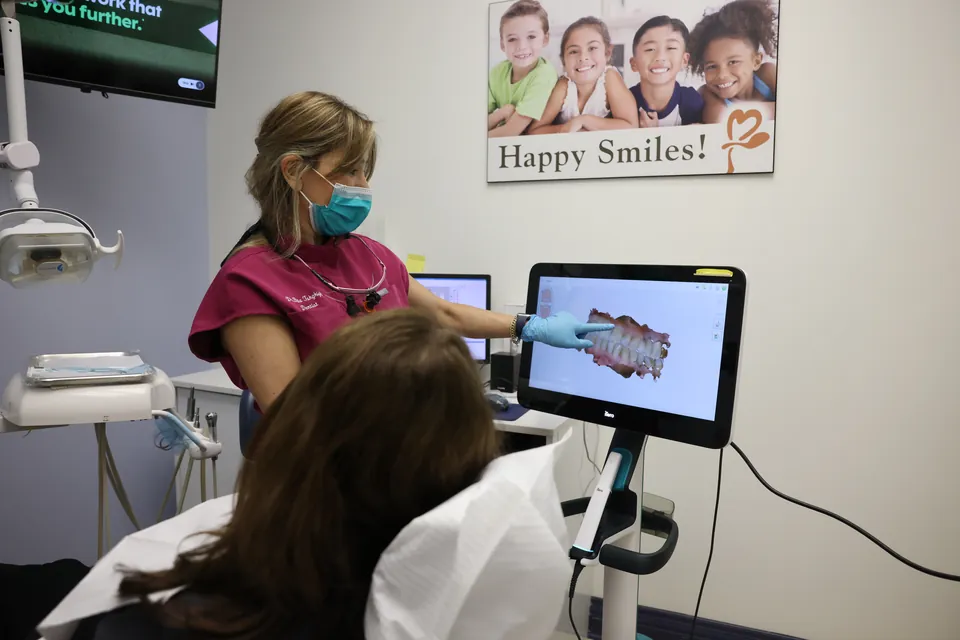
If you're in Aurora or nearby and still weighing Invisalign or braces, a consultation is the simplest next step. Dr. Farhad Sobouti, DDS, MSc (Orthodontics), FRCDC, provides our orthodontic treatment. At your visit, he looks at your bite, takes a digital 3D scan and tells you plainly whether metal braces, ceramic braces or clear aligners make sense for you.
Questions
Is Invisalign faster than braces?
Not as a rule. Treatment time depends mostly on how far the teeth need to move and how complex the bite is. With aligners, wearing them as directed also makes a big difference.
Will either one be sore?
Most people feel pressure or tenderness for a day or two after an adjustment or a new set of trays. Braces can rub the cheeks at first, and orthodontic wax helps. Over-the-counter pain relievers are usually enough, if they are safe for you.
Can I switch from aligners to braces partway through?
Sometimes. If aligners aren't moving the teeth as planned, or wear time has been hard to keep up, your dentist may suggest a change. It's a conversation to have early rather than late.
What happens if I lose an aligner?
Call the office. Depending on your stage of treatment, you may move to the next set early or go back to the previous one while a replacement is made. Don't stop wearing trays while you wait unless you're told to.
Are ceramic braces a middle option?
They can be. Ceramic braces work like metal braces but use clear or tooth-coloured brackets, so they show less. Some bites may not suit them, and your dentist will tell you if that applies.
General information, not personal medical advice. If you have pain, swelling or an injury, call us at 289-475-5497.